
Kevin Warsh

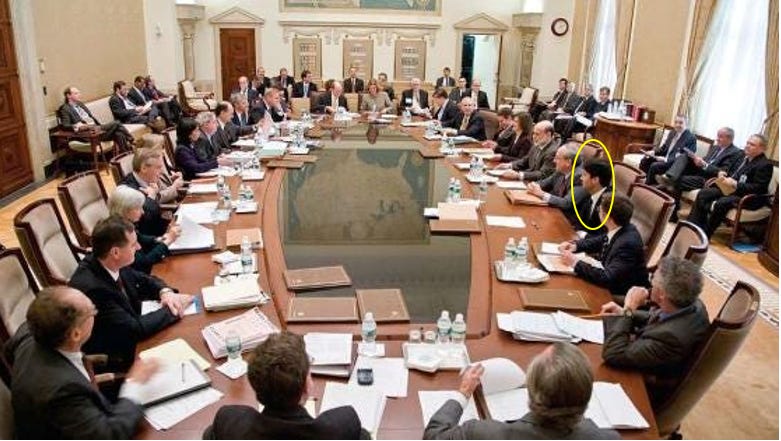
Last week, President Trump nominated Kevin Warsh to be the next Fed Chair. There’s much speculation on how Warsh would lead the Fed, what his views on monetary policy actually are, and whether he could build a consensus to lower interest rates. Start with his record. He was a Federal Reserve governor from 2006 to 2011. That’s when I started to form my opinions of him as a central banker.
Today’s post puts Kevin Warsh ‘in action’ by sharing some of his remarks at the Federal Open Market Committee meeting in early November 2010. It was a momentous time at the Fed, and Warsh was a voting member with four years of tenure on the committee. At that meeting for the first time, the Fed agreed to expand its balance sheet for the sole purpose of trying to strengthen the economic recovery. The stress in financial markets and the free fall in the economy that had motivated the Fed’s prior balance sheet program had ended. However, unemployment was still high, inflation was low, and the federal funds rate had already been cut to zero.
Warsh was outside the consensus at that meeting. He opposed the new program, though ultimately he voted for it. The transcript of that meeting provides a wealth of insights into Kevin Warsh and the Federal Reserve.
Is Warsh a hawk or a dove?
There’s a lot of chatter about whether Warsh is a “hawk” or a “dove.” Does he prioritize inflation and financial stability (a hawk) or employment and growth (a dove)? These are simplistic labels, and it’s more useful to set his views in context.
November 2010 is one such context. When it was his turn to talk about economic conditions, Warsh opened with some ‘humor’ about the labor market:
Like many of you, I will start narrowly and then go broader. The report on economic activity in my neighborhood in Georgetown is strong. [Laughter] Also, President Dudley mentioned that he visited upstate New York, where I’m from, and he noted that the economy there appeared to be “hunkered down.” That’s not a near-term phenomenon—it’s been going on for about 40 years. [Laughter] He also noted that the economy there was at a tipping point, and that is true, but the only way it ever tips is over. So, Governor Raskin [it was her first meeting], I did that just so you could see a contrast between Governor Yellen’s formal, proper, prepared remarks and my more ad hoc remarks, and you can decide which one is your model.
The national unemployment rate was 9.6%, and initial jobless claims were averaging around 450,000 per week—both more than double the current levels. Against that backdrop, Warsh drew attention to long-standing inequities, the kind that are generally thought to be outside the Fed’s remit. He made a breezy jab at a serious point that Bill Dudley, then-President of the New York Fed and Vice Chair of the FOMC, had made earlier in the meeting:
… the mood in upstate New York can be summed up in two words, and I think this probably applies more broadly: “hunker down.” In other words, most businesspeople are waiting for others to move first. I take this as evidence that even a modest amount of additional stimulus could have outsized effects over the longer run by changing the dynamic from the current stasis to one in which additional demand growth led to employment gains that improve confidence. I think an improvement in confidence might cause businesses to loosen up a bit, and all of a sudden we’d be in a virtuous cycle. I also think that, in this respect, the models that we use don’t really capture that kind of “tipping point” concept.
No one at the Fed was under illusions that expanding the balance sheet would have huge positive effects on the economy. There was a keen awareness of the risks and uncertainties. (See, for example, the memos to the FOMC in 2010.) Warsh was far outside the consensus in downplaying the economy’s cyclical weakness. That should disqualify him from ever being called a dove.
On style—since Warsh mentioned it—here is how Janet Yellen, who spoke directly before him, opened on the economy. At the time, she was the Vice Chair of the Board of Governors:
The data we’ve received during the intermeeting period reinforced my view that the path to recovery will involve a long, slow slog. I expect unemployment to remain elevated for years to come, and inflation, as far as my eye can see, to run below the 2 percent level I consider most consistent with the Committee’s dual mandate. The reports from our business contacts strike me as consistent with such a forecast. Outside of housing, where conditions are dismal, they describe an economy that is growing, but only at a snail’s pace. Businesses remain focused on productivity. They are reluctant to hire and invest. They have little pricing power.
By the way, that’s what central casting for a Fed Chair looks like.
After raising his concerns about developments in financial markets and the risks of higher inflation, Warsh had more to say in substance on the economic recovery:
The U.S. economy continues to be mired in a sluggish recovery. The adjectives that many of you used are adjectives that I would use, but I would suggest that the ability of us around the table to have a material effect on that contour is overstated. Changes in fiscal, regulatory, and trade policies, which are long in the making and which have been unfriendly to economic growth for several years, are, I think, the most responsible party. [Emphasis added.] And I do not expect the economy to turn durably in a more constructive direction until these other macroeconomic policies stop being so growth-defeating …
The Fed is capable of a lot of things, but it’s not capable, in my view, of moving the dial tremendously on economic growth from here. In that sense, it makes our current situation quite different from the situation when we were deeply involved in addressing the crisis, and the risk-reward tradeoff using nonstandard tools is different from when we use conventional policy.
The bolded section is at the heart of Warsh’s views on monetary policy. It’s not data. The unemployment rate at the time he said this was five percentage points above its pre-recession level. That’s not long-standing “fiscal, regulatory, and trade policies” that are “unfriendly to economic growth,” that’s the damage from a severe recession. Warsh takes his cues in setting interest rates from “other macroeconomic policies,” that is, policies from Congress and the White House. It’s not unheard of in money/macro, but Warsh is an extreme version for a practicing central banker. That approach didn’t shift the consensus at the Fed in 2010, and it is unlikely to do so in 2026 either.
If not the balance sheet, then what?
I disagree with Warsh on style and substance in much of what he said at the November 2010 meeting, but disagreement and diversity are healthy at the Fed. Moreover, Presidents nominate individuals to the Federal Reserve, particularly for the Fed Chair, who share their worldview. Warsh is the nominee for the next Fed Chair, and now the Senate must assess his qualifications and suitability for the role. Warsh’s views on what the Fed should have done instead and why in 2010 deserve scrutiny.
Here’s how Warsh opened his remarks on monetary policy:
The path that you’re leading us to, Mr. Chairman, is not my preferred path forward. I think we are removing much of the burden from those that could actually help reach these objectives [emphasis added], particular the growth and employment objectives, and we are putting that onus strangely on ourselves rather than letting it rest where it should lie. We are too accepting of dangerous policies from others that have been long in the making, and we should put the burden on them.
I can think, Mr. Chairman, of a tough weekend that the Europeans had, particularly your counterpart at the ECB, in the spring or summer, when we all knew that the European Central Bank, rightly or wrongly, was going to take action. But Jean-Claude Trichet did not take action until very late that Sunday night, until the fiscal authorities did their part. He thought that if on Friday night he were to say all of the things he’d be willing to do, he’d be taking the burden off the fiscal authorities. He chose to wait. I think we would be far better off waiting. If we proceed on this path, as I suspect we will, I would still encourage you to put the burden where it rightly belongs, which is on other policymakers here in Washington, and to do so in a way that is respectful of different lines of responsibility.
That might sound innocuous or even common sense, but it is deeply problematic in context. Warsh, an unelected official with one of twelve votes on the planet for US monetary policy, argues in a policy-setting meeting that the Fed should withhold aid to the economy and “put the burden” on Congress to act instead. The Fed has many powerful tools, particularly during financial crises, such as emergency lending facilities and swap lines with foreign central banks. A Fed Chair should never endorse using the Fed’s tools to “put the burden” on other parts of the government. It would be worthwhile to have Warsh clarify his intent here.
The rest of Warsh’s arguments against the balance sheet expansion in 2010 were conventional. He offered several substantive reasons to oppose the new program, citing what he saw as small benefits and large risks to the economy and financial markets. Waiting to act is not uncommon at the Fed. In fact, this policy came together over several months of deliberation and evidence gathering.
After all these years, Warsh has never offered the Fed an alternative to doing nothing when the funds rate is zero and the economy is weak. That’s an incredibly bleak verdict on monetary policy for someone who wants to be Fed Chair. It’s especially worrisome as he is advocating for lower rates.
Is it a matter of loyalty?
November 2010 offers a window into another question Warsh faces on his path to becoming Fed Chair: whether he will be independent of, or loyal to, the White House. Given President Trump’s unprecedented efforts to pressure the Fed to lower interest rates, anyone who got the nomination would be under some suspicion.
At the November 2010 meeting and in the internal meetings before that, Warsh is clearly opposed to the balance sheet expansion. However, ultimately, he voted for it out of loyalty to Chair Bernanke. Here’s what Warsh said:
So having given you my views, having told you I think probably more than you or anyone wants to know about my sense of the risks, and having made a modest suggestion to alternative B, let me try to talk a little bit about my vote. How in light of all this do I justify not dissenting? If I were in your chair, I would not be leading the Committee in this direction, and frankly, if I were in the chair of most people around this room, I would dissent. My respect for you during this last four and a half years is incredibly high. I am awed by the burdens that you are confronting, and I wouldn’t want to undermine at this important moment the chance that this program could be successful. I know a lot of people around this table feel total conviction on the opposite side of where I do.
I think this is called the Bernanke Fed for a reason. I’ve got a lot of confidence that if the risks that I talk about materialize, you will not hesitate and you will change your view, you will change this experiment. That’s not just a hypothetical—when we did the LSAPs the first time, we did a $300 billion Treasury purchase, which I did not think was a good idea, and you stopped it because it was not working, and we pivoted to these mortgage-backed securities. There, again, I had my own misgivings, but I think that was more fertile ground. As I had mentioned then and frequently since, that market was broken long before we ever found it. So, I think you did some good there in the crisis, and I’ve seen your willingness to change your view, and I will count on that if these risks that I talk about, however unlikely, do end up materializing.
So-called soft dissents at the Fed—opposing an action privately in the meeting, but voting in favor of it publicly—are not without precedent. Warsh’s is a good example of the high bar for deference to the Chair over your convictions. Warsh would not walk in as Chair with such respect; no one would. It’s earned. Also, to his credit, in describing Bernanke, Warsh picks up on a critical feature of an independent Chair, “I’ve seen your willingness to change your view …”
My questions about Warsh’s independence rest more on his recent calls for “coordination” between the Fed and Treasury on the balance sheet and his ties to Treasury Secretary Scott Bessent than on his loyalty vote in November 2010.
In closing.
I have concerns about Kevin Warsh leading the Federal Reserve. Many have roots in his time at the Fed. He’s long on criticisms and short on solutions, which is troubling for someone who served as a Fed official during the largest financial and economic crisis since the Great Depression. While I have questions about his judgment and ability to maintain the Fed’s independence, I also respect his public service and commitment to economic policy. I expect his confirmation hearing will be tough. It’s imperative for all Americans that the next Fed Chair, whoever it is, is up to the task.
Bonus material: Here’s my Bloomberg interview on Friday morning after the announcement:
I would also recommend this interview with Skanda Amarnath at Employ America on Kevin Warsh’s career:
Warsh is not an economist who judges policy by the state of the economy. From what I have read he is more focused on institutions and the full array of public policies that affect the economy, of which monetary policy is but one. The fact that he believes that the policy rate as well as market rates should be down around 3% now should leave no doubt in which direction he will take the Fed and FOMC. In short, he's a political pick, not a financial or economic expert. Just a reminder: the best Fed Chairs were experts themselves: Volker, Greenspan, Bernanke, Yellen. If his history tells his story, he probably won't make that list. And the nation will be the worse for it.
I don’t think that thinking of him as a hawk or a dove is productive. As Paul Krugman I think rightly put it, Warsh is a lapdog.
Thomas Hoenig was a hawk. I had disagreements about his views, but they were transparent and principled. But Warsh is not a hawk. He’s also not a dove. He’s, first, second and last, a Republican. His views on monetary policy quite clearly depend not on economic conditions, but on the party that occupies the White House. And his public remarks in 2010 were entirely incoherent. They declared that the Fed should take its cues from market reactions. But not like… what markets actually say, but what Warsh imagines they should say. Which is why in 2010 he was yelling for tighter money because he thought that markets should be warning of coming inflation (even though they were actually doing entirely the opposite). Which makes him entirely unsuited for the role.