
Trust in Numbers
U.S. economic statistics are not being manipulated, but underinvestment has intensified.


Over the past two weeks, we have had a flood of economic data, including employment, inflation, and GDP. I usually focus on analyzing the numbers, but I also found myself addressing questions about the agencies that produce them and whether the data can be trusted. Official statistics from agencies such as the Bureau of Labor Statistics remain the highest-quality lens on the U.S. economy, but that credibility must be protected.
Don’t shoot the messenger. Get to know them instead.
The headline numbers for January jobs and inflation were better than expected. Some observers suggested that the BLS manipulated the data under pressure from the White House.
There is currently no evidence of manipulation. Even so, it is appropriate to monitor for signs of it. In August 2025, President Trump fired then-BLS Commissioner Erika McEntarfer after large downward revisions to payrolls. That episode raised legitimate concerns that the White House might attempt to pressure the agency to publish more flattering numbers. However, McEntarfer herself rejected the suggestion of interference last week:
You should still trust BLS data. The agency is being run by the same dedicated career staff who were running it while I was awaiting confirmation from the Senate. And the staff have made it clear that they are blowing a loud whistle if there is interference.
Career staff are a critical safeguard against manipulation, as are transparent, well-established procedures. The recent federal government shutdown, which resulted in no CPI surveys in October 2025, put those safeguards to the test. The situation was unprecedented. The BLS could have improvised. Instead, as the agency explained, it followed its publicly documented imputation methodology:
First, BLS did not want to intervene and superimpose last minute, unvetted judgment into the process, as this could have been perceived as manipulating the data unscientifically. [Emphasis added.] Second, BLS information technology was built and rigorously tested for the hierarchical imputation algorithm. Logistically, even if there were consensus agreement on an alternative imputation-of-last-resort method, BLS could not have written requirements, modified the systems, tested, and certified the changes in a timely fashion; that would have further delayed the release of the November 2025 CPI and subsequent releases considerably. Third, vetting a proposed alternative imputation method and gaining endorsement would take considerable time. A methodological change of that magnitude would require publication in the Federal Register and a public comment period prior to adoption.
The BLS chose procedural consistency over discretionary adjustment. That choice matters because the CPI is more than a statistic. It is written into law and contracts, such as those that adjust Social Security benefits, Treasury Inflation-Protected Securities (TIPS), and countless private agreements.
The emphasis on process safeguards against manipulation can slow the pace of methodological innovation in official statistics. Stability is a feature, not a bug. Rather than frequently altering primary surveys and headline statistics, agencies often innovate through experimental programs run in parallel. At the BLS, examples include the supplemental poverty measure, the distribution of consumer spending, the contingent (gig) work supplement, and the new tenant rent index.
The numbers are a lens, not a mirror.
Safeguarding against manipulation is necessary, but not sufficient for data to be trustworthy. Even when the process is sound, trust can erode if people feel the statistics do not align with their lived experience. Last week, the good news on inflation triggered a familiar complaint: that inflation statistics do not capture how households experience higher prices. Here is one example:
Part of the problem is that people experience inflation differently from the way economists collect and disseminate it. There is a distributed lag effect to experience. … I recall vividly coffee at $9 while it now is $12. That $12 mark hits again every time I shop, yet as long as it stays there, it will be reported as no inflation. Many, many people are objectively, materially poorer than they were not long ago, but they are being told something very different from their actual economic reality.
Regular readers know that I have thought carefully about this criticism. The issue is not statistical manipulation; it is interpretation. The CPI is a price level index, and inflation measures the rate of change in that index. Analysts often focus on monthly or year-over-year changes, but inflation can be examined over longer horizons—or one can look directly at cumulative price levels. In a recent post, I examined five-year inflation to highlight how sustained increases in the price level relate to consumer sentiment.
As I said on Yahoo Finance the morning of the CPI release, “We have to remember: people pay prices. They don’t pay inflation.”

The way economic data are reported can also create a disconnect from personal experience. Focusing on seasonally adjusted data is one example. The better-than-expected job gain in January raised some eyebrows. Here is one question I received:
Do you really think all those jobs were created in January with all the bad weather and the holidays? From my time in corporate America, nobody is interviewing and putting through hires in December.
The observation is correct. Every year in January, payrolls fall sharply as temporary holiday workers are let go. In January 2026, payroll employment declined by 2.6 million on a not seasonally adjusted basis (blue line below). But that decline was smaller than a typical January. After seasonal adjustment, payrolls increased by 130,000 (orange line)—the figure most often reported.
Seasonal adjustment removes predictable calendar patterns over the year, so that month-to-month changes reflect the underlying trends rather than seasonal swings.
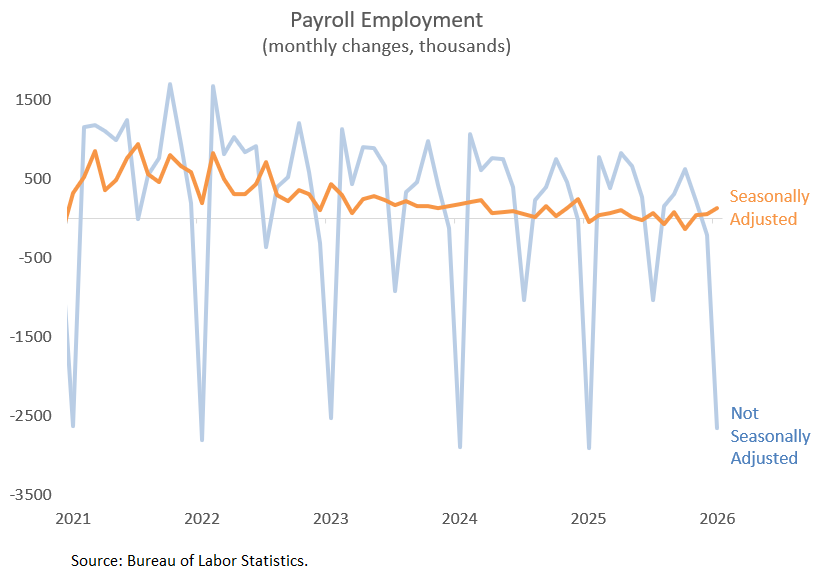
But it loosens the connection to lived experience. We live in a seasonally unadjusted world. The appropriate presentation depends on the question being asked. Seasonal adjustment itself is a complex statistical exercise, and concerns about its application arose in the January CPI. The Boston Fed provided a helpful research note on the issue.
There are deeper, more structural criticisms of economic statistics, and I am sympathetic to some of them. Sound measurement begins with a model of how the world works. When the world changes substantially, that model can become outdated, and the statistics derived from it may lose some of their explanatory power. Keeping official statistics relevant is a continuous process. The statistical agencies are filled with people committed to that work.
It’s neglect, not manipulation, that is harming the data.
I am worried about the state of U.S. economic statistics. The current problem is not political interference; it is chronic and intensifying underinvestment. Budgets for statistical agencies have failed to keep pace with inflation for years, and conditions deteriorated further during the first year of the Trump administration. The Bureau of Labor Statistics lost more than 20% of its staff since the fiscal year 2024, and 13 of its 35 leadership roles remain unfilled. Budget constraints led to a 15% reduction in the CPI sample and to the elimination of three cities from coverage. The federal government shutdown caused the first-ever break in the monthly unemployment and inflation series.
The response rate to the survey used to estimate unemployment is now lower than during the pandemic (see chart). Participation had been drifting down for years, but the decline over the past year was the steepest outside the pandemic period.
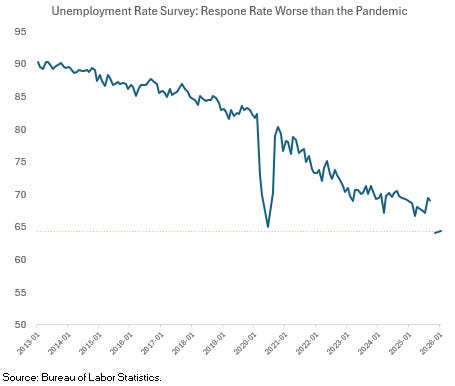
Lower response rates and smaller sample sizes make the estimates less precise and more volatile. The threat to data quality is not manipulation—it is neglect.
In closing.
Trust in economic statistics depends on more than guarding against political manipulation. It requires sustained investment and public understanding of what the numbers can—and cannot—tell us. To preserve a reliable lens on the U.S. economy, we must protect both the integrity of the data and the institutions that produce it.
Thank you for saying this. It’s been so frustrating to see the lack of trust in data.
The distinction between manipulation and neglect is one worth making loudly, because the two get conflated constantly in public discourse right now. Firing the BLS commissioner after inconvenient revisions looks like interference, so the leap to 'the data is cooked' feels intuitive... even when the career staff are the ones actually holding the line.