

A question I was asked repeatedly this year on Bloomberg: “Are you confident inflation is going back to 2%?” Early in the year, I said yes; the temporary boost from energy prices and tariffs would wane, delivering the necessary disinflation. By the end of the summer, I was much less confident. In September, I shifted to favoring modest rate hikes as insurance against persistently elevated inflation. Risk management was a signature approach of the Powell Fed and was also the most common reason given in the FOMC minutes for the September rate increase.
Information since the September meeting has underscored the upside risks to inflation, while the labor market has remained in balance. Long lags between changes in the policy rate and their effects on inflation argue for adjusting policy sooner rather than later. Other considerations, such as higher long-term interest rates, the timing of the midterm election, and the potential for a market surprise, are insufficient to justify a hold in October. Currently, futures markets imply less than a 20% chance of a rate increase next week, partly reflecting patient messages from Fed leadership in recent weeks. The case for a rate hike is stronger than the odds suggest.
Weighing the risks.
Normally, the outlook for inflation and employment drives the Fed’s decisions about the appropriate federal funds rate. Because interest-rate changes take time to work their way into economic outcomes, today’s appropriate policy rate hinges on beliefs about inflation and employment a year or two out. Many of the shocks underlying inflation have causes external to the economy: military conflicts in the Middle East and Ukraine, the ratcheting up of tariff rates to promote domestic production, large swings in immigration policy, and an emergent general-purpose technology in artificial intelligence. Uncertainty around these shocks means a baseline forecast is insufficient. Central bankers must also consider risk scenarios.
Risk management does not bias the FOMC toward holding rates steady. Gathering more information may help under uncertainty, but waiting is not costless when inflation is elevated, and additional inflationary pressures remain. If inflation proves to be higher next year, the FOMC cannot go back to the October 2026 meeting and raise rates. However, if inflation comes in lower than expected, it can cut rates and reverse some of the restriction. That reversal is relatively cheap from where policy sits today: one quarter-point increase from a level most officials describe as around neutral or only slightly restrictive. Raising rates modestly now as insurance against upside inflation risks is, in principle, the mirror image of cutting rates modestly last year as insurance against downside employment risks.
Uncertainty about the supply-side shocks hitting the economy is heightened, and there is always some uncertainty about how monetary policy works through the economy. How much is enough to bring inflation down? The Fed has one tool, interest rates, and how sensitive overall demand is to rate changes is complicated. Fed Governor Bowman has argued that, under uncertainty, it is best to move slowly and see how the economy responds before raising rates again. Cleveland Fed President Hammack has made the opposite case, for “small adjustments relatively quickly.” Timing isn't everything in monetary policy; October versus December is not pivotal. But waiting can raise the odds of a catch-up later. I still have the four consecutive 75-basis-point hikes in 2022 seared into my brain. It worked, but I wouldn’t want the Fed to test it too often.
The standard for raising rates that Warsh offered at Jackson Hole in August evokes risk management by centering on confidence:
We must be confident that underlying inflation is moving to our objective, clearly and at sufficient speed. Otherwise, we have work to do.
The minutes from the September FOMC meeting show that risk management was the most common reason for the rate hike:
In their consideration of monetary policy at this meeting, all participants supported raising the target range for the federal funds rate 1/4 percentage point to 3-3/4 to 4 percent. … Based on the outlook and the changing balance of risks, all participants viewed a higher target range for the federal funds rate as appropriate. Participants judged that this would support a timelier return of inflation to the Committee’s 2 percent goal. Many participants emphasized that a higher path for the target range would be prudent on risk-management grounds, providing insurance against inflation remaining persistently above target due to stronger-than-expected demand or further adverse supply shocks. A number of participants viewed a higher path for the target range as necessary based on their modal outlooks rather than on risk-management grounds. Some participants remarked that a higher policy rate would diminish the risk of persistently elevated inflation unanchoring inflation expectations and becoming further entrenched.
Economic data inform how we assess risk, but so do geopolitical events, policy changes, and technological developments. There is no go-to model, like the Taylor rule, for applying risk management principles. The reaction function is more complicated. In some ways, that’s why I like Warsh’s confidence test. My first step in gauging confidence is the incoming economic data.
Confidence in disinflation slipped further.
Forming a view on inflation doesn’t hinge on a single data release. It starts with the trend. Inflation has been above the Fed’s target for more than five years, but the path matters more than the level. Inflation, as measured by the 12-month percent change in PCE prices (below), picked up sharply in 2021 and 2022, peaking at 7.2% in June 2022. From mid-2022 to mid-2024, inflation fell sharply after the Fed raised the federal funds rate by more than 5 percentage points. In September 2024, inflation was 2.3%; after a brief blip, it returned to that low in March 2025.
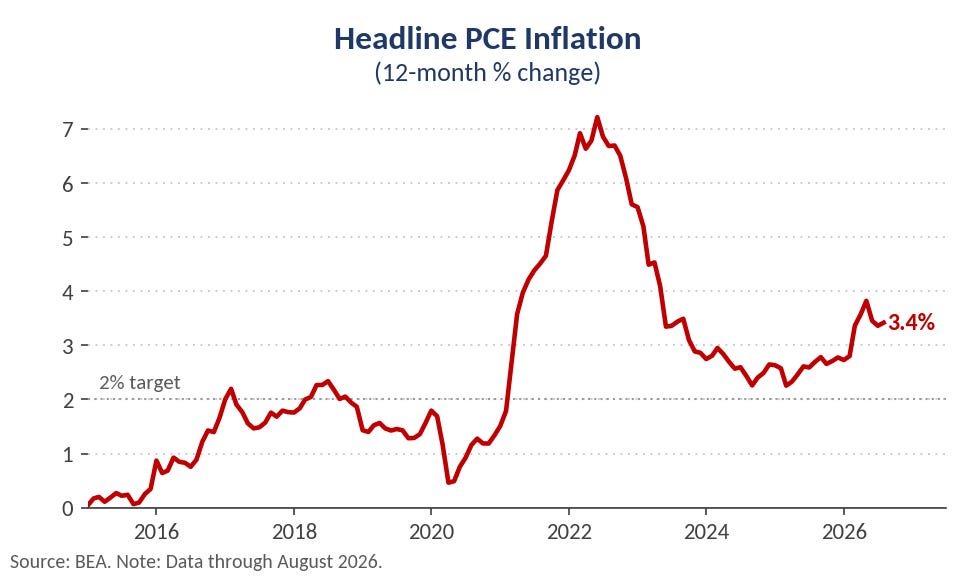
Since then, PCE inflation has drifted up and then risen more sharply this year, partly due to energy disruptions. Energy prices eased from their spring peak but are climbing again, and even a sustained decline would not be enough to calm concerns. The first-round effect of higher energy prices fades mechanically, while the pass-through to food and to airfares and other core prices builds for months after the shock. In August, PCE inflation was 3.4%, well above the Fed’s target. The broader pattern does not inspire confidence in a timely return to 2% inflation, raising the question of whether getting there will require further tightening. The details of the inflation data, including the latest CPI and PPI, are critical to gauging disinflation prospects.
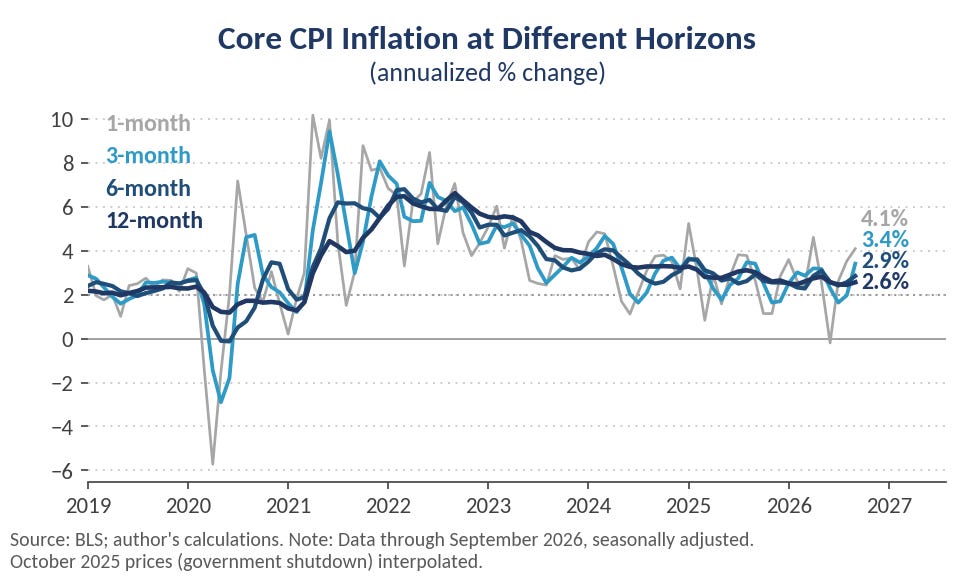
The September CPI offered little to build confidence in disinflation. First, the upside surprise was broad-based, unlike in August, when it was concentrated in wireless services. Second, while energy drove the 0.6% headline increase in September, core CPI, which excludes food and energy, rose 0.33%, an annualized rate of about 4%. Finally, the disinflation over the three-month horizon (orange line below), which Fed Governor Waller had highlighted as a possible inflection point before the August CPI, reversed.
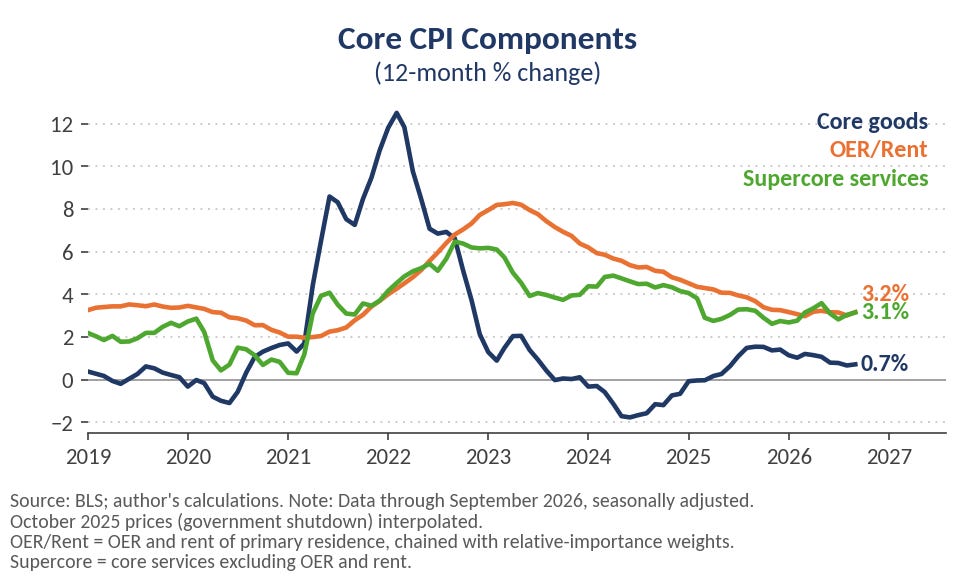
The key components of core CPI through September point to broad risks. Housing (owners’ equivalent rent and tenants’ rent), the purple line, had been a steady source of disinflation but has largely flattened out this year. Core services excluding housing, referred to as supercore (the green line), firmed in September and has moved sideways for about a year. And core goods inflation (the blue line), boosted by tariff pass-through, remains positive; before the pandemic, falling goods prices routinely offset services inflation, and that offset is gone. A sharp reversal in energy prices would bring headline inflation down, but the lack of disinflation in core points to broader risks beyond energy to hitting the target sustainably.
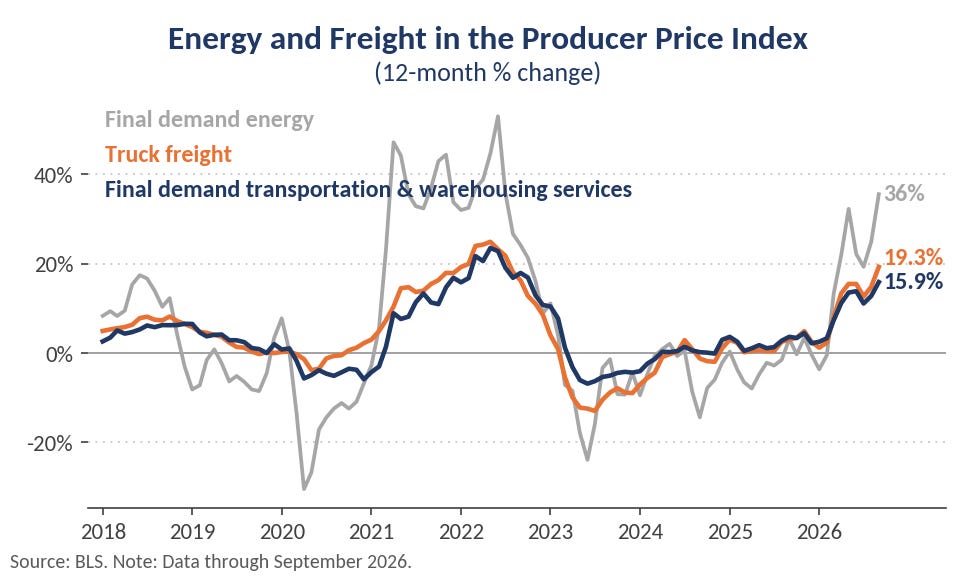
The September PPI shows even more pricing pressure in the pipeline. The direct effect of higher energy prices was as clear in the PPI as in the CPI, and the PPI also shows those energy costs feeding into non-energy goods and services, the second-round effects. Prices that U.S. businesses charge for transportation and warehousing services (blue line) continued to rise sharply in September and are now increasing at a pace last seen in 2022. Whether those costs end up in higher consumer prices or in squeezed business margins is an open question. Weaker demand, including from a higher federal funds rate, is what would tip the answer toward smaller margins.
The Beige Book also reinforced the upside risks to inflation. Across the country, reports noted higher oil prices, and fuel surcharges were cited as a way to pass costs along the supply chain. The Cleveland District tied higher freight costs to “tighter capacity, fewer available drivers, and higher fuel costs.” The pass-through to consumers is uneven. In the Kansas City District, “Most firms reported being able to pass the costs on to consumers. However, services firms reported less ability to increase their selling prices, putting more pressure on their own margins.”
It’s more than a month’s worth of data releases and anecdotes. Geopolitical developments also matter. There has been no material progress in the Middle East or in the Ukraine-Russia conflict since the Fed met in September, and oil futures show the strain. Brent for delivery in December 2027 is around $90 per barrel, the highest since the conflict began. Markets are less convinced of a rapid reversal in oil prices, and if traders are losing confidence in oil-price disinflation, that is another source of upside inflation risk next year.
Reasons to wait fall short.
According to the federal funds futures, the chance of a rate hike next week is only 17%. Three weeks ago, the market odds were as high as 70%, but a series of remarks from Williams, Jefferson, and Warsh can account for most of the decline. Generally, the Fed does not like to surprise markets, but new inflation data can be a reason to. The patient messages from Williams and Jefferson came before the September CPI and PPI. Only two voters have spoken since: Warsh, who did not engage with the data, and Hammack, who did and argued for more tightening. Moreover, markets are pricing in more rate hikes through next year, so an October hike could be a shift in timing rather than a change in terminal rates. My case for an October hike does not mean that a December hike is a foregone conclusion. A risk management approach weighs new information as it comes in. If the bar is met for a hike, then do so. Whether the Fed hikes or holds next week, the statement and press conference must accurately convey the Fed’s reasons.
The Fed’s vote next week is less than a week before the midterm elections. The Fed must ignore that fact. Whatever the Fed’s decision, it must ground it in economics, not politics, even if that puts the Fed at risk of political attacks. The Fed’s independence allows it to set rates without political interference. If it moves away from that, even to delay until after the election, it weakens its claim to independence.
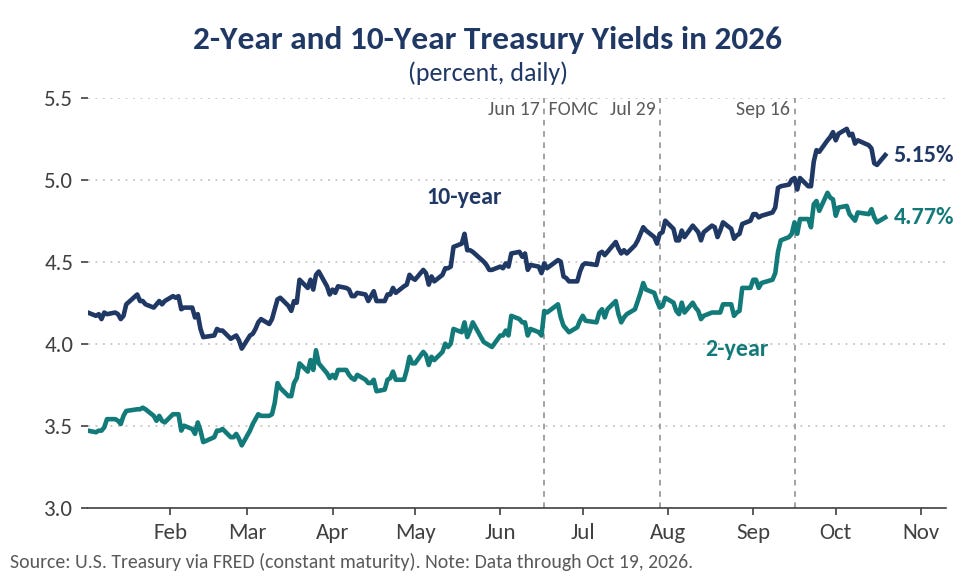
Some Fed officials, including Warsh, Waller, and Logan, have suggested that higher Treasury yields could do the Fed’s job for it and reduce the need to raise the federal funds rate. Currently, the 10-year Treasury yield (blue line) is only about 10 to 15 basis points above its level after the Fed’s September vote. Market conditions could change before the meeting, but recent rate volatility underscores the challenge of leaving rate decisions to the market. Only the Fed can do its job.
In closing.
Inflation is elevated, while unemployment is low and stable. That’s the present, but monetary policy must look ahead. During the past six weeks, the upside risks to inflation over the next year have grown. Raising rates next week reduces the odds that those risks become reality and force larger hikes later. A rate hike is not urgent, but it is prudent. If the Fed holds next week, Warsh should explain why the committee is confident PCE inflation is moving to 2% clearly and at sufficient speed, and what in the data or world events tells him so.
Incisive, as always.
I'm at a total loss to understand how the Fed can "be confident that underlying inflation is moving to our objective, clearly and at sufficient speed."
If the Fed holds I wouldn't bet a lot that Warsh will explain the committee's confidence. For that matter, I fear I wouldn't bet a lot Warsh will explain the committee's thinking no matter what it does.
I really liked how clearly you showed that confidence in inflation falling has slipped. The point that waiting is not free, and a small hike now can work like insurance, made a lot of sense.