

Hike or hold? That is the question when the Fed meets next week. Going in, it’s clear that Fed officials are divided on the answer. The division isn't the kind that a single CPI print will resolve. In today’s post, I explain why I moved recently from hold to hike as the appropriate policy. My Bloomberg interview before Warsh’s Jackson Hole speech covered some of my argument, and here I go deeper on the inflation analysis.
In the end, I am no longer confident that PCE inflation will move back to 2% in the next year or two without the Fed raising interest rates. Above all, the upside risks to the inflation outlook have worsened since July. I view a modest increase in the funds rate, starting with a quarter point in September and maybe 50 or 75 basis points higher in total by the end of the year, as a way to ensure inflation is trending down in a timely way.
My case for a hike is risk management
The incoming inflation data have been mildly encouraging, but the headlines are tilting the odds toward a rate hike: stalled progress in the Middle East, a trade war with Canada, and chip shortages from the AI buildout.
The inflation data alone could clear the bar for a hold, barely.
PCE prices through July count as evidence of disinflation relative to the spring. Both headline and core PCE inflation are off their peaks earlier in the year. But it’s modest. In his Jackson Hole speech, Warsh said that the data this summer “do not tell me that underlying trends have meaningfully improved.” The 12-month changes have made only slow progress. Fed Governor Chris Waller, instead, highlighted the 3-month changes as more encouraging. This week we receive the main inputs for the August PCE: PPI and CPI. Consensus points to further disinflation, but inflation remains far from 2%.
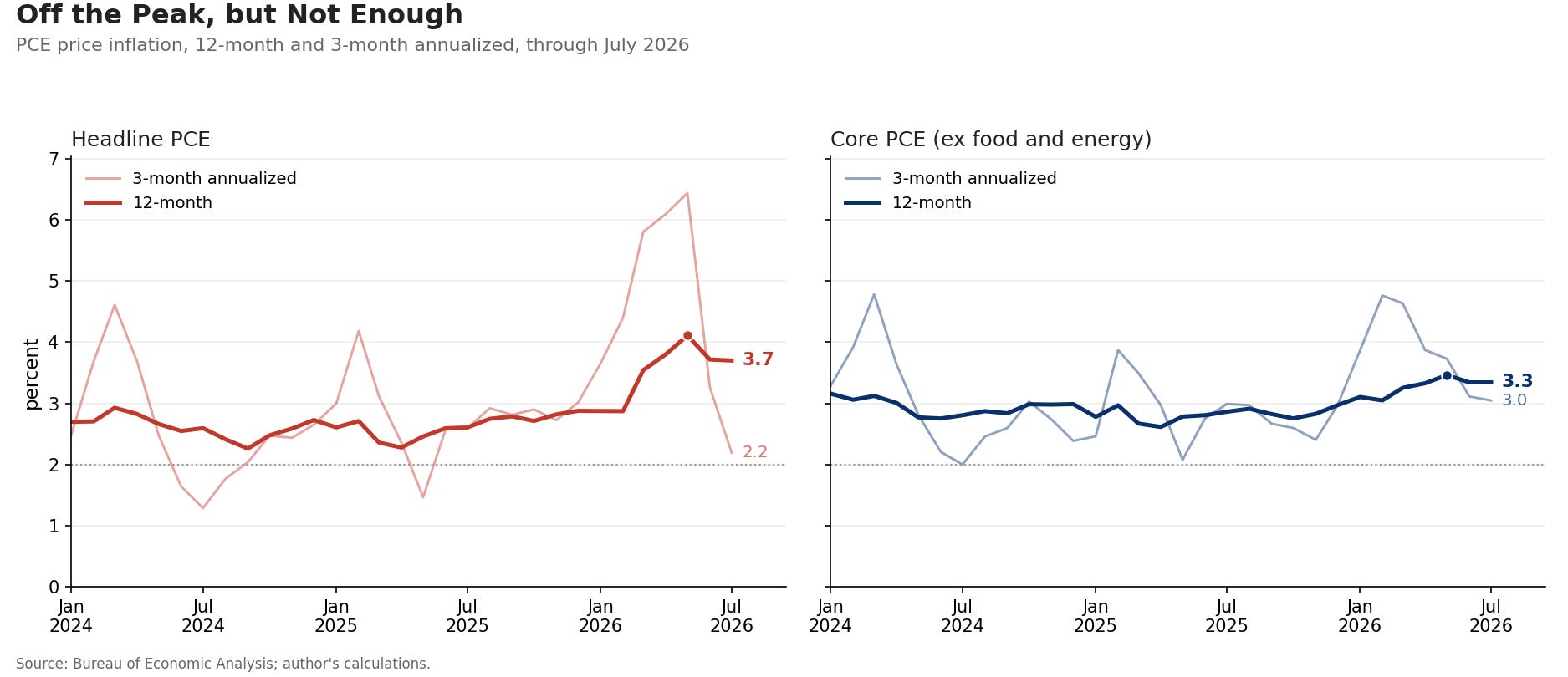
On this one, I am closer to Warsh than Waller. I am skeptical of putting so much weight on 3-month changes. PCE has had a seasonal pattern to it in recent years—higher early in the year and lower later in the year. Core PCE rose 0.2% in July, or 3.0% at an annual rate. That was down from the monthly pace in the first half of the year but still well above the 2% target. Giving back the early-year heat isn’t real progress; it’s getting back to last year’s pace, which was also too high.
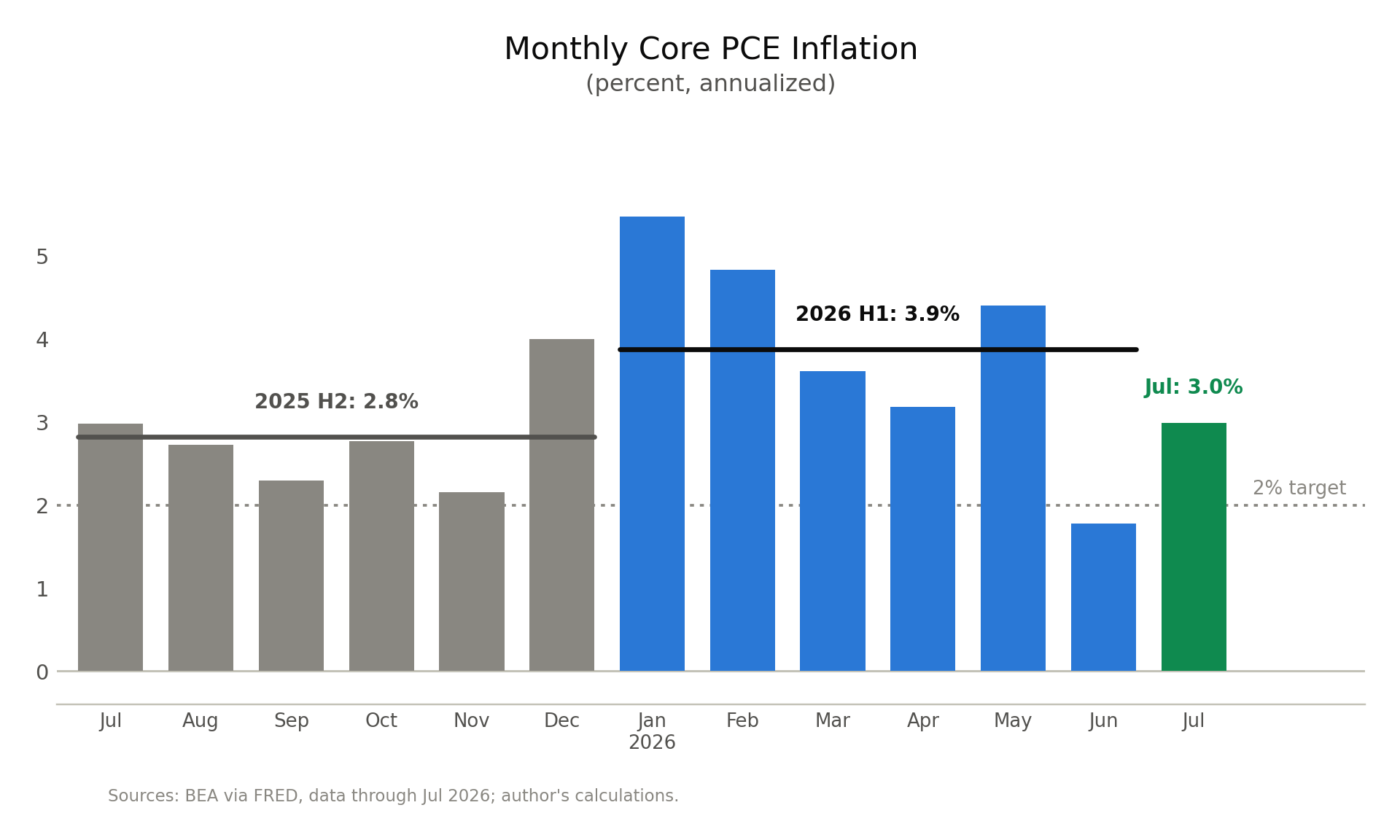
If the disinflation is modest, and the labor market is solid, why not hike? Put differently, why has the Fed held all year, and why did I agree until a few weeks ago? The answer is the type of shocks behind the inflation. The big jump in tariff rates last year boosted goods price inflation, but once the higher costs are reflected in prices, the tariff effect fades. The same logic applies to the energy supply disruptions in the Middle East: energy prices jumped, and when the conflict ends, they will come back down and pull inflation down with them. Shocks like these raise prices for a time, not forever, so raising rates against them risks unnecessary pain, cutting demand to fight inflation that would fade on its own. The inflation data in hand largely fit that narrative. The risks to the outlook no longer do.
Risk 1: A prolonged conflict in the Middle East is likely to bleed into non-energy prices.
An increase in energy prices, on its own, is not a good reason for the Fed to raise interest rates. However, persistently higher energy prices that bleed into non-energy prices may warrant a response. Historically, airfares jump quickly when energy prices rise; beyond airfares, core prices respond much less and more gradually, with the pass-through peaking a year or more later (left chart below). The effect on core is small—a 10% increase in gasoline prices adds about 0.2 percentage points to core inflation over the following year. The longer energy prices stay high, the greater the inflationary effects.
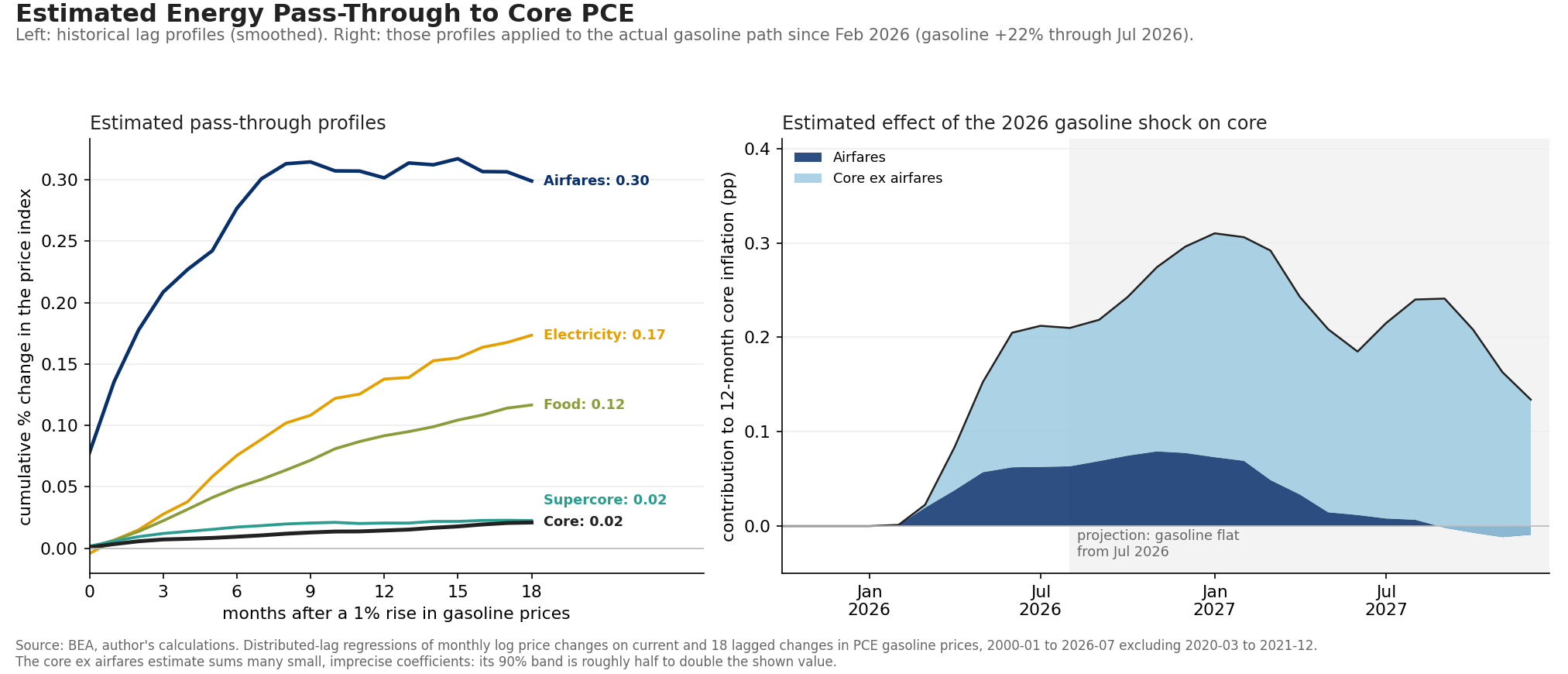
At the start of the conflict in the Middle East, a rapid resolution might have been a reasonable baseline. That is no longer the case. If gasoline prices stay at their current level, then we should expect the boost to core inflation to rise into next year (right chart above). Gasoline is at its highest-ever level for Labor Day weekend, and diesel hit an all-time high last week. Refined energy products, especially diesel, raise transportation costs of a wide range of goods and services. The lack of progress in opening the Strait of Hormuz is creating upside risks for my core inflation outlook.
Risk 2: The trade war with Canada suggests tariff increases may not be over.
On tariffs, the FOMC minutes from July showed that most Fed officials viewed the effect of tariffs on inflation as having largely peaked and expected it to wane. The unwind is visible: the 3-month annualized percent change in core goods prices spiked after the tariffs took effect last year, peaking early this year, and has moved down considerably through the summer (chart below).
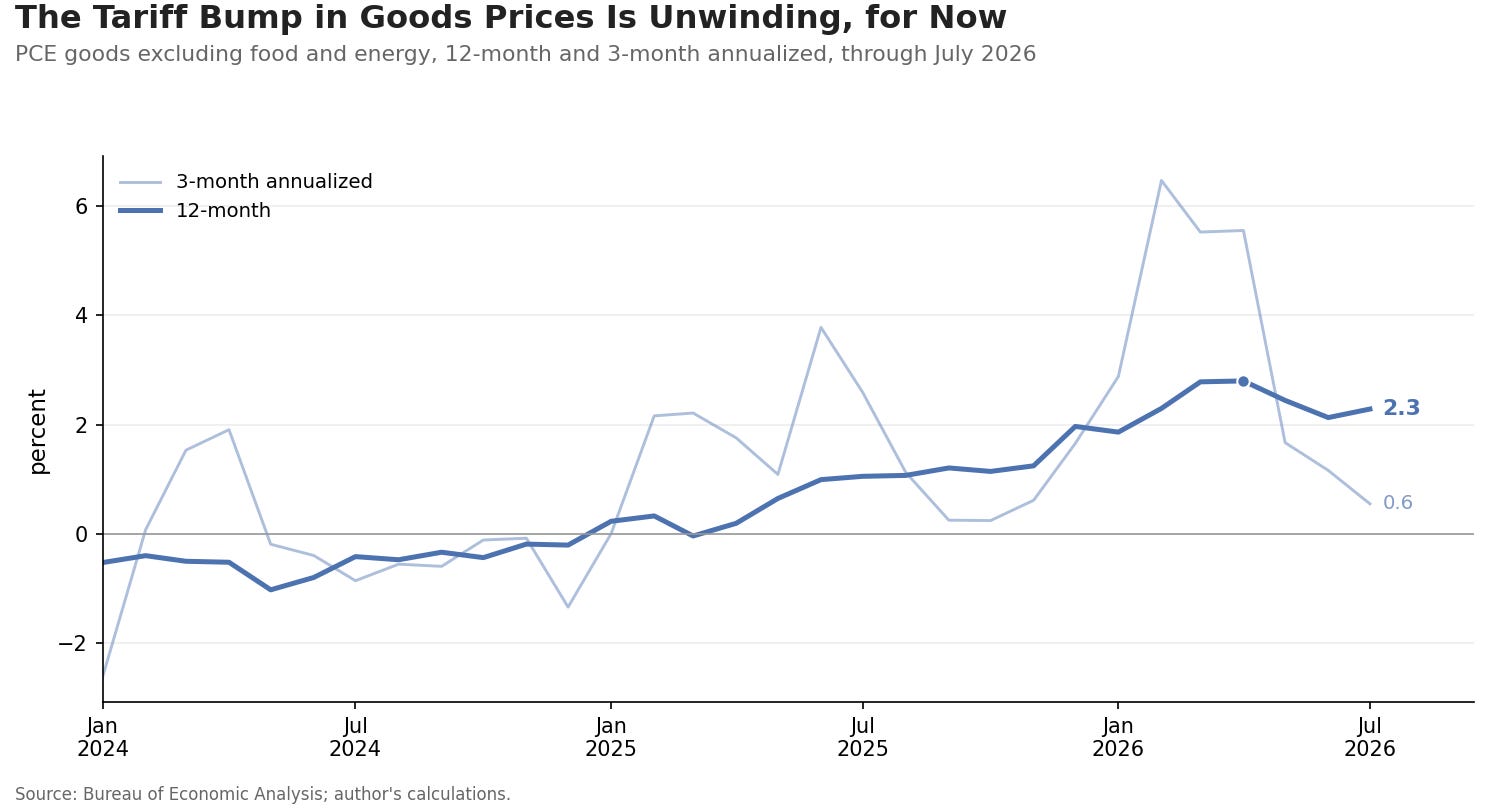
A forecast of further goods disinflation assumes that tariff rates do not rise further. While the dollar value of Canadian imports subject to additional 50% tariffs is limited, Canada’s retaliatory tariffs on US goods risk further increases in US tariffs, which could raise inflation. The episode shows that the president is not done using tariffs as a negotiating tool. The upside risks to tariff-related inflation have also risen since the last Fed meeting.
Risk 3: The AI buildout will continue to push up inflation in the next few years.
Finally, the strength of the AI buildout risks more upward pressure on inflation through memory-chip shortages. Nvidia’s recent earnings report showed that AI demand remains strong, with hyperscaler capital spending expected to exceed one trillion dollars next year. AI may be disinflationary over five or ten years, but over the year ahead— the horizon that matters most for monetary policy—the effects are likely inflationary. The consumer and business investment price data already show clear signs of rising memory prices, and while these may be relatively narrow categories of spending, the direction adds to inflation risks (chart below).
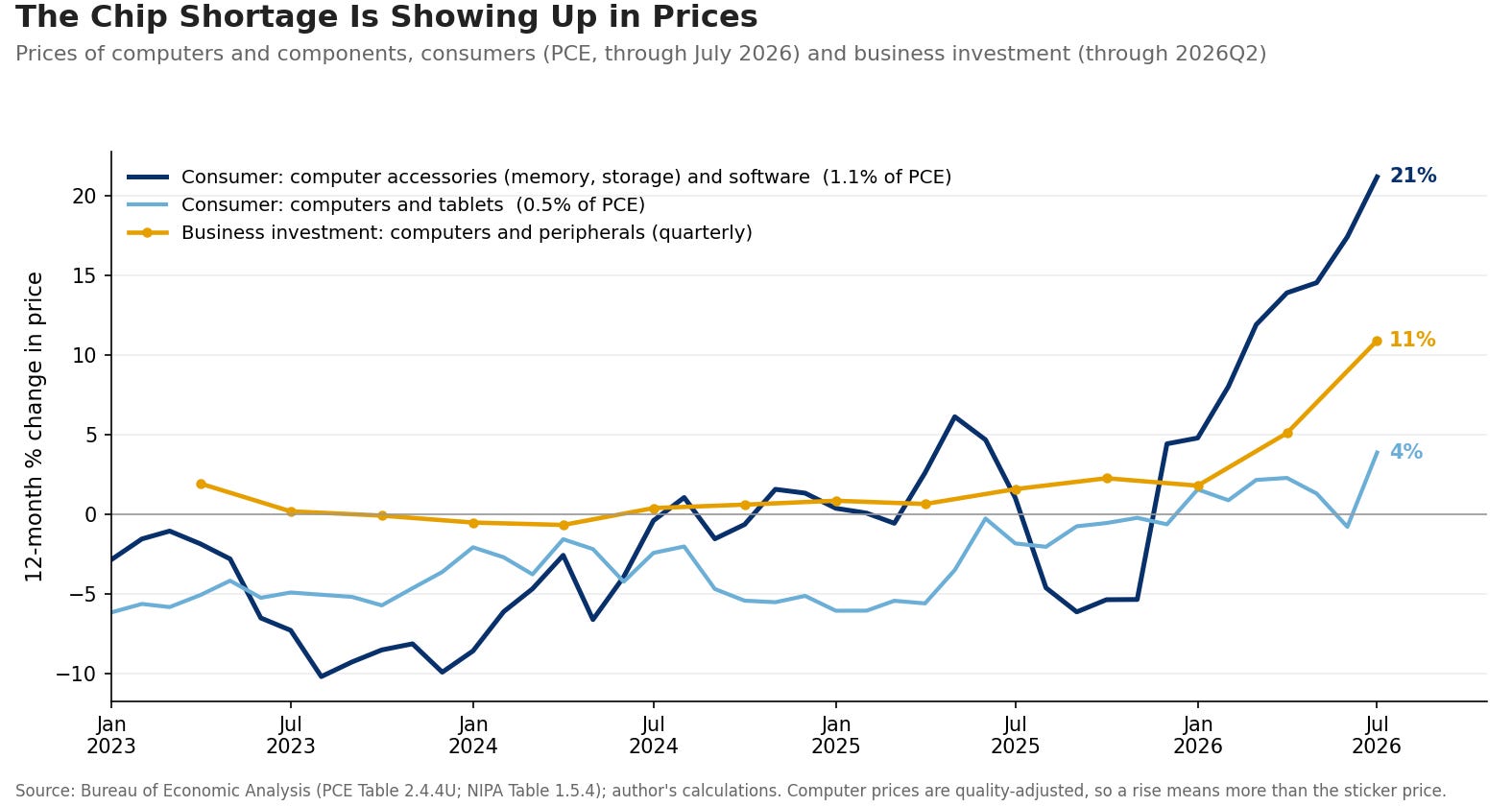
The AI buildout is a demand-driven, not supply-driven, factor pushing up inflation. The logic of the Fed “looking through” energy prices or tariffs should not extend to memory chip shortages.
Putting it together, my base case is still disinflation, but the upside risks are sizeable and span several categories. In the spirit of risk management, it is appropriate for the Fed to move to a more restrictive stance. Yes, hiking into disinflation might strike some as odd, but it’s not just about hitting 2%; it's about inflation trending down, with confidence, in the next year. Modest tightening now is insurance against growing upside risks to inflation.
Evolving views on what’s best for monetary policy
I can see the argument for staying on hold, especially if one weighs the data in hand over the outlook and risks. Better inflation data this week, or better headlines on the risks I flagged, could put me back in the hold camp. What’s best for monetary policy requires constant reassessment.
The September meeting, with a new Summary of Economic Projections, will shed light on how Fed officials are processing the same information. The SEP is an individual activity, not unlike this post, and the starting point for the Committee’s deliberations. Whatever its flaws as a communications tool, the dot plot has real strengths in surfacing a range of views and refining one’s thinking.
I know. Since 2024, I have participated in a shadow SEP run by Jon Hilsenrath, now hosted at Duke University, with submissions from former Fed officials and staff. I won’t submit my September survey until after the August CPI, but here is how my dot plot has evolved (chart below). Before the March meeting, I was still looking for cuts this year; by June, I had moved to a hold; now I see a couple of hikes and a higher path in the years beyond.
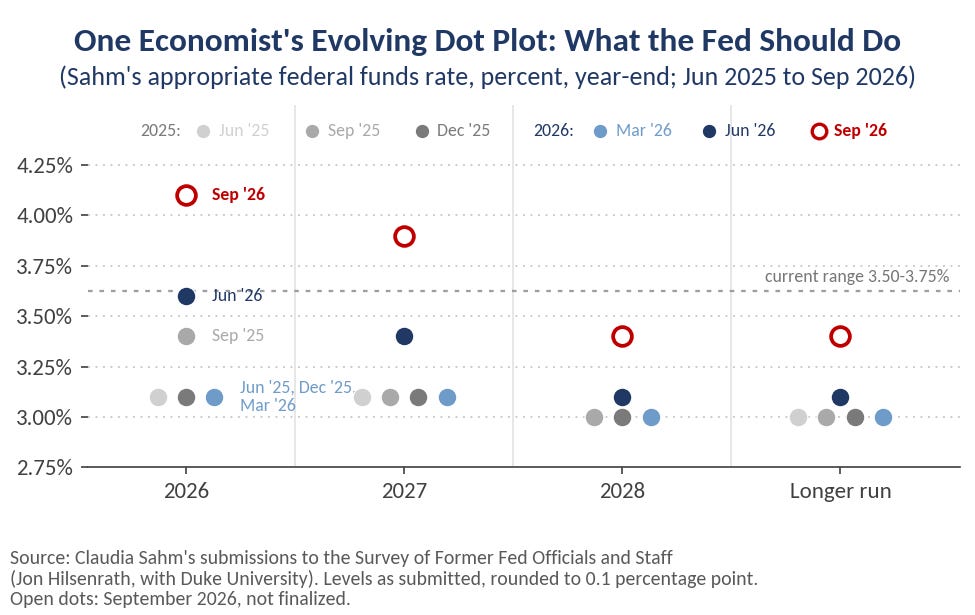
Unlike the Fed's dot plot, one meeting and multiple people, mine is one person and multiple meetings. For the Fed to hike, officials who have seen holding as appropriate will have to flip, as I did. I won't pretend to know how they will fill out their SEPs; it's a close call. I bring up my own dot plot to emphasize the discipline the SEP helps create.
In closing
Hike or hold will be a tough call. The inflation data alone could keep the Fed on hold, but the upside risks to inflation have darkened the outlook to the point that I see a modestly higher federal funds rate as appropriate.
Whatever the Fed decides next week, hike or hold, we deserve a good explanation. I don’t particularly mind going into an FOMC meeting uncertain of the outcome, but I have zero tolerance for leaving a presser uncertain of why the Fed did what it did. The July FOMC statement, Warsh’s presser, and even to some extent the FOMC minutes left many questions about the hold unresolved. If the majority of the Fed remains confident that inflation is going back to 2% soon, I want to hear it; if not, it’s time to take action to restore that confidence.
Walsh seems to be performing a good impression of Chauncey Gardner in the movie “Being There.”
“Whatever the Fed decides next week, hike or hold, we deserve a good explanation. I don’t particularly mind going into an FOMC meeting uncertain of the outcome, but I have zero tolerance for leaving a presser uncertain of why the Fed did what it did. The July FOMC statement, Warsh’s presser, and even to some extent the FOMC minutes left many questions about the hold unresolved. If the majority of the Fed remains confident that inflation is going back to 2% soon, I want to hear it; if not, it’s time to take action to restore that confidence.” — Claudia Sahm
Great point by Dr. Sahm about Summary of Economic Projections (SEP) being a useful exercise for formulating a view about how to make the interest rate decision.
Cleveland Fed nowcasters projecting that monthly core PCE rates will be 0.27% for August and 0,28% for September. So, as Dr. Sahm says, little sign of PCE inflation coming back to 2% any time soon.
If FOMC does not raise rate at this September meeting coming up, it will be more difficult for them to raise the rate at their October 27-28 meeting just before the mid-term elections. I know that they are not supposed to think about politics, but it would be hard not to do so.
I'm still inclined to wait and see with Fed rate unchanged, but that's a gut feeling without Dr. Sahm's experience in this field.