

The Fed voted 10 to 2 last week to hold rates steady at 3 3/4 to 4 percent. Fed Governor Lisa Cook and Cleveland Fed President Beth Hammack dissented in favor of a quarter-point increase. I agree with the dissenters, but today’s post is about Fed communication, not rates. That’s my bigger concern.
Comms confusion at the Warsh Fed
I have tried hard to piece together communications at the Fed since Warsh took the helm, cataloging the ups and downs and even offering some unsolicited advice. It’s time for me to revise some of my prior guidance on the Warsh Fed. My post, “Read the Minutes, Fade the Presser,” on August 20 was partly wrong. I stand by “fade the presser,” or, in non-finance jargon, ignore it; it’s low on substance. My revision now is: ignore the minutes and the statement, too. Want an accurate signal on why the Fed made its decisions and what it might do next? Follow New York Fed President and Vice Chair of the FOMC, John Williams. Williams gave clear, accurate forward guidance in his “Unwavering Dedication” speech on September 29 (between the two meetings). The October statement even echoed his call to accumulate information. Williams is the one to read.
On Friday, Richmond Fed President Tom Barkin, a non-voting official this year but one of the best communicators on the FOMC, said on SiriusXM radio (my emphasis added in bold):
I think the direction of travel is pretty straightforward. I think the question though is pace. And so what we said at our September meeting is we signaled a gradual approach.
I think gradual makes sense when you're not much behind the curve where you want time to learn, both from the economic environment and the external environment.
And so we haven't seen much change since then. I think a gradual approach is a good way to go, and we'll see what we learn over the next period of time.
We can argue about the merits of gradualism, often expressed at the Fed as every-other-meeting policy changes, but nothing from the September meeting said the committee had chosen it. September was a unanimous vote to raise; the statement cited a “timelier return” to 2% inflation as the reason, and the presser was full of strengthening growth talk. Even the September minutes three weeks later did not mention gradualism. Risk management was in those minutes, but that’s not the same as gradualism. Last year, risk management was expressed in consecutive moves. Even October decision day didn't mention gradualism. Instead, Warsh pointed to an “information-rich period” ahead. The first public hint of gradualism came after the September meeting, in Williams’s speech, and other officials have echoed it since.
Tired of the twists and turns? I am too. Listen to Williams for the committee view and guidance. Listen to individual Fed officials for their views. Curious about Warsh? Get an AI-Ouija board. Gradualism (unless something breaks) should translate into a quarter-point hike in December, a hold in January, a quarter-point hike in March (if inflation hasn’t improved), and then a reassessment of the approach. I am rooting for Team Transitory 2.0, and I’d love for hikes to be unnecessary, but the comms are a mess. Compare Warsh’s explanation of the hold at the presser to Barkin’s:
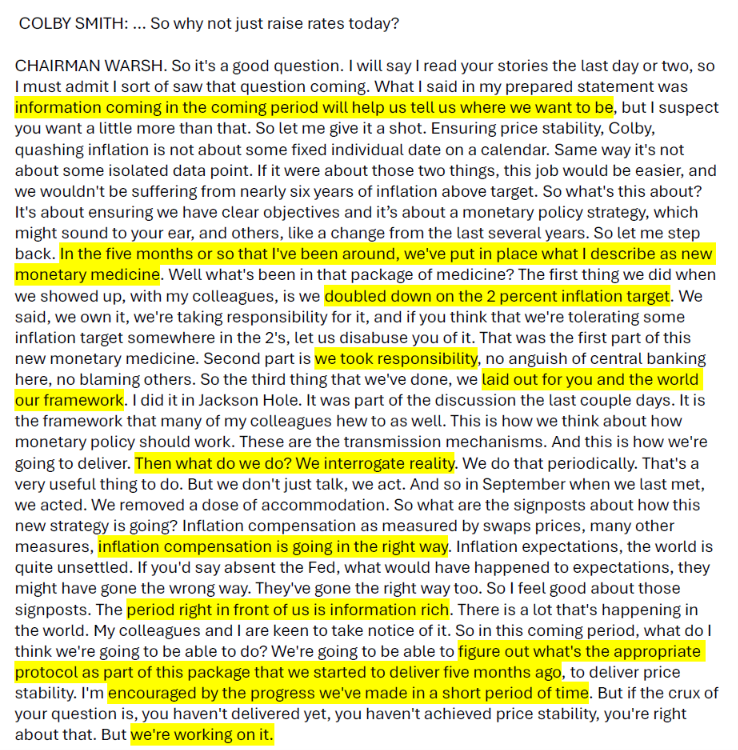
I don’t know what to say beyond the obvious: that’s not a sensible answer to a basic question. Warsh’s reason for the hold may be hiding in there, but it’s his reason, not the committee’s. Barkin’s interview makes more sense, and he says the committee decided on gradualism in September. Why is this Fed so confusing? Because right now, the one person who speaks for the committee isn’t doing it well.
Fed communication is accountability, not just words
The decision to hold is defensible; the decision to obscure the reasoning is not.
A Fed that communicates poorly puts the institution at risk. Congress has given the Fed independence in its monetary policy decisions, and the Supreme Court has upheld those protections so far. Even so, the Fed is an institution within a democracy and accountability is part of the deal. Communicating the reasons for its policy decisions is a basic building block of accountability.
Warsh is still relatively new as Chair, and some adjustment period is understandable. However, it appears that Warsh is trying to roll back decades of increasing transparency at the Fed. We will see about that. Something the Fed doesn’t always talk about is that many of its opening-up moves came under pressure from Congress. The five-year release of transcripts exists because Rep. Henry González pushed Greenspan on it, relentlessly, in 1993. In his memoir, Bernanke tied the timing of the first press conference in April 2011 to politics: “after the blowback that greeted our introduction of QE2 in November 2010 … we needed more than ever to explain our policies clearly and effectively.” The blowback included a letter from Republican leadership in Congress. Congress created the Fed; it oversees it, and it can change it. The Fed knows that.
Democratic accountability of the Fed runs through Congress. The midterm elections on Tuesday are an accountability exercise for Congress, and one that could have implications for the Fed. Poll after poll shows that affordability is a top issue for voters this year. Again. Years of prices rising faster than people are used to come at a human cost. It’s not all the Fed’s fault, but its decisions are in the middle of it. Congress is likely to face direct accountability for higher prices: Democrats are widely expected to retake the House and possibly the Senate. Regardless of how the votes play out, the emphasis on affordability keeps the Fed under scrutiny.
How might a change in leadership in Congress affect the Fed?
Many aspects of Warsh’s reform agenda require committee support, and more like-minded Fed officials would help him. Governor seats require Senate confirmation. A Democratic-led Senate would make it harder to confirm Trump nominees for the Fed, so as terms like Powell’s expire in January 2028, or if someone leaves, the seats would likely go unfilled. That’s a consequence of the current arrangement, not a feature of it: the Fed’s governance depends on a Senate willing to deal, which is one more reason to write the rules down rather than leave them to whoever holds the gavel.
Committee chairs in Congress can call hearings and request more in-depth analysis from the Fed. I recall Maxine Waters, who would likely chair House Financial Services again, keeping senior staff on their toes when she was chair before. Elizabeth Warren, as chair of Senate Banking, would have requests for Warsh. He received no Democratic votes in the Senate Banking Committee for his confirmation, so he has no reservoir of goodwill to draw on.
Getting answers out of the Fed doesn’t require changing the Federal Reserve Act. Warsh has barred journalists from asking follow-up questions or multi-part questions. He can do that at the Fed for now, but not at his twice-a-year Humphrey-Hawkins hearings before the House and Senate. Congress can’t force Warsh to be substantive, but it can keep pushing for an answer. Why? Because Americans deserve one.
Democratic accountability paired with political independence at the Fed is a challenge, and it’s been an ongoing effort. I was thrilled to see a new project, “How to Hold the Federal Reserve Accountable to the Public Interest,” supported by the Roosevelt Institute. From the introduction:
Our hope is this collection is the beginning of a more ambitious discussion of reforms to the Federal Reserve system that will deliver not only more accountability to the public and more democratic outcomes but a stronger economy for everyday Americans. This series lays out ideas that must inform a core set of democratic updates to the 21st-century Federal Reserve system’s monetary policy setting authorities, if it’s to perform its core macroeconomic role. These are a baseline set of needed reforms, not the full menu of reforms we need if we are to address the ways in which the Fed’s broader responsibilities are failing to serve the American people.
Ethan Struby, Erin Lockwood, and Christian Flores lay out the stakes of Fed communication and propose concrete steps Congress could take to improve democratic accountability at the Fed. Struby wants FOMC members required to publish their forecasts with names attached and explain them. Lockwood wants the Fed to justify the 2% target to Congress every year, in public hearings. Flores wants the Fed’s current practices, from the policy statement to the Summary of Economic Projections to eight meetings a year, written into statute as a floor rather than left as norms a Chair can undo. All three want Congress to build the staff expertise to ask the Fed hard questions. Here is a video of an event with the authors that I moderated:
In closing.
As Bernanke often said, monetary policy is “98 percent talk and 2 percent action.” Warsh hits that ratio on word count versus rate changes, but not on content. Quality matters. There are checks on a Fed Chair who communicates poorly, from colleagues like Williams and Barkin to committee chairs in Congress, but those are workarounds, not a stable equilibrium. Confusing communication is more than an annoyance for Fed watchers; it makes it hard to hold the Fed accountable, and that puts its independence and good economic outcomes at risk.
Funny that a 10 to 2 vote with both dissents leaning toward a hike still leaves the Fed looking this hard to read. At least rates at 3 3/4 to 4 aren't squeezing growth, and Williams as the clear signal helps. Do you think the market starts leaning on his speeches more now?
Yes, Warsh is providing no rationale for holding rates steady. He insists the Fed is firmly committed to 2% but won't explain why at a time inflation is well above target, has been for years, and is not meaningfully declining (perhaps increasing), the Fed is not taking more action. When pressed - why aren't you doing more than talking given the current conditions - he repeats his commitment to 2% and often criticizes the questioner for being impatient. Everyone recognizes 2% will take time, but we'd like to see movement in the right direction.
Cutting the number of rate setting meetings is not exactly encouraging.
One frightening thing at the press conference was referring to AI as super-intelligence, Trump's favorite term.